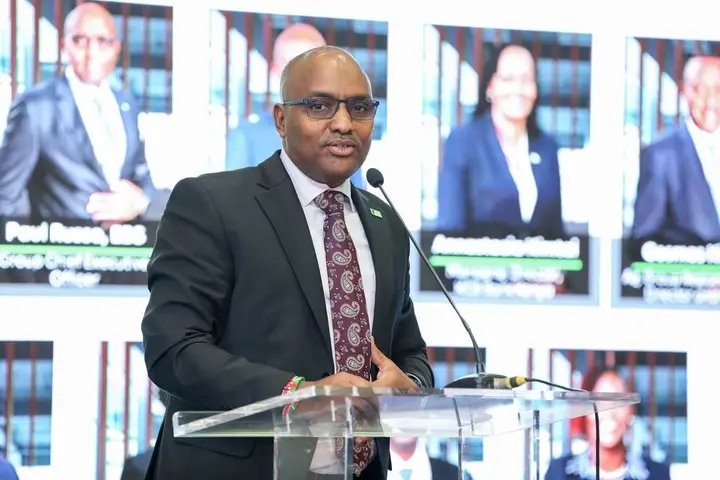
The appointment of Sitoyo Lopokoiyit as Chief Executive for Personal and Private Banking at Absa was intended to underscore the bank’s ambitions in digital finance and innovation. Instead, it comes against the backdrop of a High Court judgment that has already cost Safaricom Sh1.4 billion and imposed an ongoing royalty obligation tied to one of its M-PESA products.
At the centre of the dispute is a copyright case brought by local innovator Peter Nthei Muoki and his company, Beluga Ltd, over a youth-focused mobile wallet concept that eventually evolved into a costly legal battle for East Africa’s largest telecommunications company.
In 2021, while serving as Managing Director of M-PESA Africa and acting Chief Financial Services Officer at Safaricom, Lopokoiyit became involved in discussions concerning Muoki’s proposal for a USSD-based parental-control mobile wallet known as M-Teen Mobile Wallet.
According to court records, Muoki had spent months developing the concept and registering the work with the Kenya Copyright Board. The proposal was designed to allow parents to monitor spending, set transaction limits and manage sub-accounts for teenagers and young adults using mobile phones.
The proposal went beyond a broad business idea. Muoki documented detailed USSD menu structures, commands and user-response sequences. On March 13, 2021, he submitted the concept to Safaricom through then Chief Customer Officer Sylvia Mulinge. After receiving no response, he continued pursuing engagement and eventually reached Lopokoiyit, who had assumed leadership of M-PESA Africa on April 1, 2021.
In correspondence cited during the proceedings, Lopokoiyit responded in May 2021 that the proposal faced practical and regulatory challenges. He noted that teenagers aged between 13 and 17 did not possess national identification cards and indicated that approval from the Central Bank of Kenya would be necessary.
Muoki subsequently sought a meeting, and on June 22, 2021, the two met at Mediterraneo Restaurant at Nairobi’s Junction Mall. According to court filings, Lopokoiyit informed him that Safaricom had already been exploring a similar concept and offered to connect him with a third party.
Seventeen months later, on November 26, 2022, Safaricom launched M-PESA Go, a product that enabled parent-linked accounts for children and teenagers, spending controls, transaction monitoring and other features that became central to the subsequent litigation. Internal references to the project reportedly included names such as Manage Child Account and Manage Junior Account.
The dispute eventually landed before the High Court.
In Civil Suit E407 of 2022, Justice Josephine Wayua Mong’are found that while the general concept of a youth wallet with parental controls was not protectable under copyright law, Muoki’s documented expression of the idea, including the specific arrangement of USSD menus, commands and responses, qualified as a literary work under the Copyright Act.
The court concluded that Safaricom had infringed that copyright.
A significant aspect of the judgment was the court’s treatment of Safaricom’s evidence. The judge drew an adverse inference from the company’s failure to produce key internal documentation that could have demonstrated independent development of the product.
Safaricom argued that related concepts had existed internally before Muoki’s submission and referred to a Huawei proposal dating back to September 2020. The court was not persuaded, describing aspects of the evidence as an attempt to retrospectively establish a documentary trail. The judgment also rejected reliance on alleged verbal advice from the Central Bank Governor regarding product development.
On May 8, 2026, the court awarded Muoki and Beluga Ltd Sh1.4 billion in general damages, calculated at one percent of M-PESA’s 2024 financial-year revenue. In addition, Safaricom was ordered to pay a continuing royalty equivalent to 0.5 percent of gross M-PESA revenue for every financial year from March 31, 2025, for as long as it operates M-PESA Go, Manage Child Account or any substantially similar parent-child functionality.
The court declined to issue an injunction that would have shut down the service, citing the potential disruption such a move would cause to existing users.
The ruling has placed renewed scrutiny on Safaricom’s handling of external innovators and intellectual property. Critics argue that the case highlights the risks companies face when engaging with independent inventors without maintaining clear records and governance safeguards around product development.
The financial implications are potentially substantial. M-PESA remains Safaricom’s most important revenue driver, and the royalty obligation could translate into hundreds of millions of shillings annually if upheld through the appeals process.
For Lopokoiyit, the judgment arrives as he takes on one of the most influential retail banking roles in the region. Absa announced his appointment citing his extensive experience in telecommunications, financial services, customer-value creation and large-scale business transformation.
The court did not find Lopokoiyit personally liable for copyright infringement. However, the chronology outlined in the judgment places him at the centre of interactions between Safaricom and the innovator whose work ultimately formed the basis of the successful claim.
The ruling has also revived discussion of earlier allegations surrounding Safaricom’s handling of SportPesa-related paybill numbers during Lopokoiyit’s tenure. Those allegations have never been conclusively determined by a court, and no findings of wrongdoing were made against him. Nonetheless, their re-emergence alongside the latest judgment has prompted renewed debate about governance, oversight and decision-making within major corporate institutions.
Regulators, investors and industry observers will now be watching closely as Safaricom pursues an appeal against one of the largest intellectual-property awards ever issued against a Kenyan company.
For many entrepreneurs, the case has become a landmark test of whether local innovators can successfully challenge large corporations over the ownership and use of commercially valuable ideas.
For Safaricom, the stakes extend far beyond the Sh1.4 billion award. The appeal will determine whether the company can overturn a judgment that threatens to impose a continuing cost on one of its most important products.
For Lopokoiyit, the ruling ensures that questions surrounding the handling of Muoki’s proposal will remain part of the public record as he begins a new chapter at the helm of Absa’s personal and private banking business.
The case has already become one of the most consequential intellectual-property disputes in Kenya’s corporate history, raising difficult questions about innovation, ownership and accountability in the country’s fast-growing digital economy.