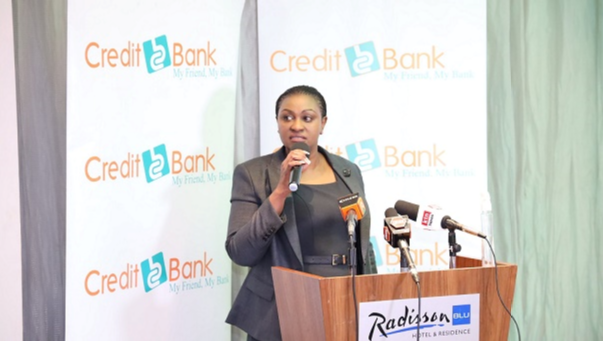
The numbers, when placed side by side, are staggering in their brazenness. As of March 31, 2026, Credit Bank Plc held Sh1.36 billion in core capital the bedrock shareholders’ equity that regulators use as the primary measure of a lender’s solvency.
Against that same capital base, the bank had extended Sh1.37 billion in credit facilities to its own directors, employees, chief executives, and their associates.
To put it plainly: Credit Bank has lent to its insiders more money than it has in owner equity. The rule it has broken could not be simpler. It has broken it completely.
The breach, disclosed today in Business Daily and corroborated by the bank’s own quarterly filings, places Credit Bank in direct violation of the Central Bank of Kenya’s Prudential Guidelines, which are unambiguous on the matter.
An institution shall not grant or permit to be outstanding any advances, credit facilities, financial guarantees, or other liabilities to insiders amounting in aggregate to more than 100 percent of its core capital. Credit Bank is at 100.7 percent and rising.
Credit Bank lent Sh1.37 billion to its own insiders directors, executives, staff, and their associates against a core capital of just Sh1.36 billion. It has effectively lent to insiders more money than it owns.
The timing could not be more damaging. Credit Bank is simultaneously fighting for its survival on the capital adequacy front, having missed the December 31, 2025 deadline to raise its core capital to Sh3 billion under the Business Laws (Amendment) Act, 2024.
Four months after that deadline passed, the bank remains Sh1.64 billion short of the minimum. CBK Governor Kamau Thugge ruled out any grace period at the Monetary Policy Committee briefing on Wednesday.
The question that now demands an answer is not just why Credit Bank failed to raise capital in time, but where its money was going while it should have been shoring up its equity.
CBK’s insider lending rules exist for a reason written in blood.
The collapse of Imperial Bank in 2015 and Chase Bank in 2016 two of the most traumatic episodes in Kenyan banking history were both driven substantially by insider lending that circumvented regulatory oversight.
At Chase Bank, loans to directors reached Sh13.62 billion against a reported book of Sh5.72 billion, a discrepancy that only became visible when the institution tipped into insolvency.
At Imperial Bank, investigators uncovered concealed insider liabilities exceeding Sh16.6 billion, much of it through loans to companies owned or connected to senior management. Both institutions were placed under receivership. Thousands of depositors are still waiting for full recovery a decade later.
CBK’s prudential framework, forged directly from those disasters, is explicit: directors, chief executives, and management must not use their positions to further their personal interests
The regulator restricts any single insider borrower to 20 percent of core capital, and the aggregate of all insider loans to 100 percent. The intent is to prevent an institution’s lending book from becoming a personal ATM for the people who run it.
Credit Bank has breached the aggregate cap.
Its Sh1.37 billion in insider loans exceeds its Sh1.36 billion core capital by Sh10 million a margin that, while arithmetically slim, represents a complete regulatory breach. The bank faces penalties of up to Sh5 million for the violation, with the Banking Act providing for an additional Sh20,000 per day for every day the breach continues. But the financial penalty is almost beside the point. The governance signal is the catastrophe.
THE NUMBERS AT A GLANCE
|
Bank |
Core Capital |
Insider Loans |
Breach Ratio |
|
Credit Bank |
Sh1.36bn |
Sh1.37bn |
100.7% — BREACH |
|
Consolidated Bank |
-Sh541m (negative) |
Sh436.7m |
Technically infinite — BREACH |
Source: Business Daily, CBK disclosures, Q1 2026 bank filings, Auditor General report (March 2026)
The insider lending breach is not merely a governance footnote. It is a material contributor to the capital crisis the bank now faces.
Every shilling extended as an insider loan is a shilling that is not working as productive capital generating returns that would bolster the equity base.
When those insider loans are non-performing as a significant proportion of Credit Bank’s book demonstrably is, given the bank’s persistently elevated NPL position they become a direct drag on capital through provisioning requirements.
Credit Bank’s gross loan book stood at Sh15.8 billion in Q1 2026, deliberately frozen as management retreats from new lending amid deteriorating asset quality. The industry’s gross NPL ratio was 15.6 percent of gross loans as at March 2026 according to CBK data.
If Credit Bank’s insider loan portfolio carries NPL exposure even broadly in line with the rest of the book, the provisioning burden on that Sh1.37 billion insider exposure alone could represent hundreds of millions of shillings in charged-off equity.
The bank is already loss-making a pre-tax loss of Sh26.6 million in Q1 2026, improved from Sh68 million a year earlier, but still bleeding. Insider lending at this scale, poorly managed, does not merely violate a rule. It corrodes the capital base from the inside.
Every shilling locked in insider loans is a shilling not generating returns for shareholders and if those loans are non-performing, they are actively destroying the equity the bank needs to survive.
There is a further dimension that has received insufficient scrutiny. In mid-December 2025, Credit Bank’s shareholders approved a Sh4.5 billion private placement at an EGM held on December 19. Two anchor shareholders Sansora Group of Companies and Shorecap III LP committed Sh1 billion each to the regulator.
The Sh2 billion was supposed to be enough to push core capital past the Sh3 billion threshold before the December 31 deadline. It was not. The bank entered 2026 still in breach, and it is still in breach today.
Against that backdrop, the revelation that Sh1.37 billion was sitting in insider loans as of March 31 raises uncomfortable questions about resource allocation and the priorities of those who run the institution.
Credit Bank is not a faceless institution. It was founded in 1986 under the patronage of the late Cabinet minister Simeon Nyachae, one of the most powerful political figures of his generation. His daughter Grace Nyachae sits on the board as a founding director. His son Leon Nyachae is the chief executive of Sansora Group, which owns approximately 27 percent of the bank’s shares and has a board seat. Eric Nyachae, another family member, formerly served in the bank’s executive structure in charge of business and strategy. The family’s fingerprints are on the institution’s governance at every level.
CBK’s prudential guidelines are specific about the obligations of such insiders.
They encompass not just directors and senior management, but their associates a category that under the Banking Act extends to companies in which directors hold a significant interest, and family members of directors.
When Sh1.37 billion in insider loans appears on Credit Bank’s books, the question of who exactly is classified as an insider, what due diligence governed those credit approvals, and what the NPL status of those facilities is, becomes a matter of public interest rather than internal housekeeping.
The bank has not publicly disclosed a breakdown of its insider loan portfolio by category staff loans versus director facilities versus associate company borrowings.
CBK’s Prudential Guidelines require each individual insider exposure to remain below 20 percent of core capital, meaning no single insider should have credit facilities exceeding Sh272 million at Credit Bank’s current capital level. Whether those single-borrower limits have been respected within the aggregate breach is unknown from public disclosures.
Consolidated Bank: An Even Starker Picture
Credit Bank does not stand alone in the insider lending dock. Consolidated Bank of Kenya state-owned and already operating with negative core capital of Sh541 million had lent its employees Sh436.7 million as at March 2026, a figure that grew by 6.3 percent from a year earlier even as the institution’s equity was deep in the red.
The Auditor General Nancy Gathungu had already flagged the breach in her review of Consolidated Bank’s financials for the year ended December 2025, noting in a report dated March 30 that staff loans of Sh434.9 million stood against a negative core capital balance of Sh546 million.
For a bank that is technically insolvent where shareholder equity is negative, meaning depositors’ money is funding the institution’s entire asset base lending additional hundreds of millions to employees represents a governance failure of a different order.
No core capital exists against which the insider lending limit can even be measured.
The government has budgeted a Sh1.25 billion Treasury injection for Consolidated Bank in the financial year beginning July, but that money has not yet arrived, and its passage through a budget process under National Assembly scrutiny is not guaranteed.
What CBK Must Do Now
The CBK’s response to the insider lending breach at Credit Bank will be watched carefully. Under the Banking Act, penalties for violating Section 11(1)(g) the aggregate insider borrower limit start at Sh5 million and can escalate to Sh20 million, with daily accruals for continuing violations.
Those fines, in the context of a bank that is already loss-making and capital-deficient, are almost irrelevant as deterrents. What matters is whether the regulator moves to compel the bank to reduce its insider loan exposures and to whom it turns to explain how Sh1.37 billion in insider credit was extended and managed while capital was being eroded.
The CBK’s 2024 Bank Supervision Report, published last August, had already cited unnamed institutions for exactly these categories of breach flagging banks that had violated the aggregate insider borrower cap of 100 percent of core capital.
Credit Bank’s breach was apparently not new.
What has changed is that it is now public, specific, and quantified, and it is occurring at a moment when the bank is under the most intense regulatory scrutiny of its 40-year existence.
Governor Thugge’s position is clear: no grace periods, no extensions, no forbearance. Banks that cannot meet capital requirements must act, or face consequences ranging from downgrade to microfinance status to licence revocation.
The governor said on Wednesday that three institutions Credit Bank among them remain in breach of the Sh3 billion floor, four months after the deadline. He did not say what enforcement action was imminent. But the accumulation of violations capital inadequacy, insider lending breach, persistent losses, NPL overhang makes Credit Bank’s position uniquely precarious among the four non-compliant lenders.
The Depositors’ Exposure
Behind the regulatory arithmetic sit 22.9 billion shillings of ordinary Kenyans’ deposits. Credit Bank’s customers grew their deposits by Sh3.6 billion in the year to March 2026, a figure the bank’s chief executive Betty Korir cited as evidence of customer confidence.
That confidence may not be warranted.
A bank with a capital base of Sh1.36 billion intermediating Sh22.9 billion in deposits is operating at a capital-to-deposit ratio of approximately 5.9 percent below the CBK’s own required ratio of 8 percent. Every one of those depositors is exposed to a governance and capital structure that is failing on multiple dimensions simultaneously.
Kenya’s Deposit Protection Fund provides coverage up to Sh500,000 per depositor. For individual savers, that backstop exists. For businesses, corporates, and the SME clients that form the bulk of Credit Bank’s customer base, any resolution event would likely involve losses. The Sh1.37 billion in insider loans sitting on the books is not abstract: it is money that could, in a resolution scenario, reduce the pool of assets available to repay ordinary depositors.
Credit Bank has been promising transformation since at least 2021, when it launched a five-year plan targeting Sh49 billion in assets and Tier II status. That plan has expired. Total assets stand at Sh28.3 billion, less than 60 percent of the target. The bank is still Tier III, still loss-making, still capital-deficient, and now revealed to be lending its own insiders more than its entire equity base. The time for plans has passed. What Credit Bank needs now is not another EGM resolution or another unnamed investor whose documents are sitting in CBK’s vetting queue. It needs governance that puts depositors before insiders, and capital that is real rather than promised.
CBK is not in the mood to wait.