The queue at Nyayo House stretches past the parking lot most mornings. Ordinary Kenyans — teachers, nurses, young professionals preparing for their first trips abroad — wait in those lines for hours, sometimes days, to claim a document they are constitutionally entitled to.
Many are turned away for minor paperwork deficiencies. Many pay expediting fees that never appear on any official receipt. Many simply give up.
Meanwhile, inside the same building, a select group of Sudanese nationals — several of them bearing names that appear on Washington’s most feared blacklists — apparently walked through a different door entirely, their applications fast-tracked, their biometric checks bypassed, their digital footprints scrubbed, their Kenyan passports delivered with the discreet efficiency of a luxury concierge service.
The evidence that this happened did not emerge from a disgruntled civil servant or a frantic whistleblower pressed against the outside wall of a government ministry.
It came from the United States Treasury Department itself — one of the most authoritative financial enforcement bodies on the planet — which quietly updated its sanctions register on February 19, 2026 to note that Algoney Hamdan Dagalo Musa, a senior figure in Sudan’s genocidal Rapid Support Forces (RSF) and a man already under US and EU sanctions, holds Kenyan passport number AK1586127.
The passport is not a forgery. It is an officially registered Kenyan travel document. And the man named in it was already on Washington’s blacklist when it was issued.
This is not merely a bureaucratic embarrassment. It is a national security crisis, a diplomatic catastrophe in slow motion, and — sources and analysts agree — the most devastating evidence yet that Kenya’s passport system has been quietly weaponised to serve the interests of powerful foreign actors while ordinary Kenyans are left in queues.
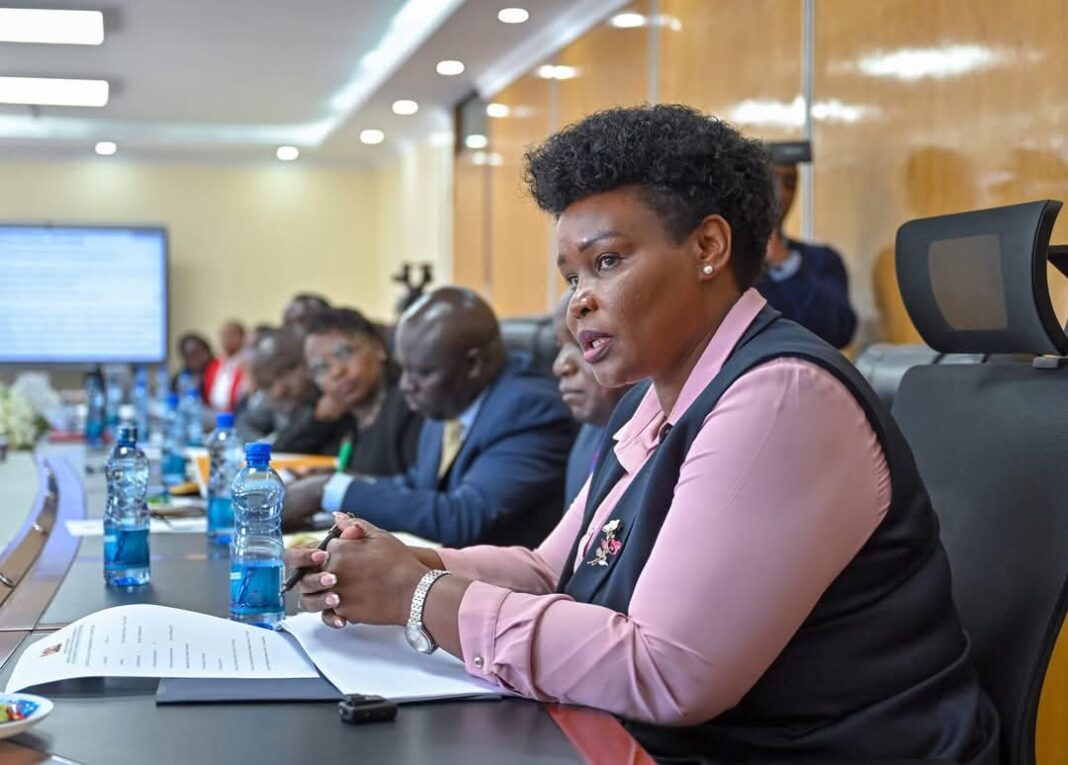
At the centre of the storm, whether she wishes to be or not, sits Director General of Immigration Services Evelyne Cheluget.
THE SMOKING GUN FROM WASHINGTON
On October 29, 2024, the US Treasury’s Office of Foreign Assets Control (OFAC) formally sanctioned Algoney Hamdan Dagalo Musa for his role in procuring weapons, vehicles, and logistics networks that sustain the RSF’s military campaign — a campaign the United Nations has described as carrying the hallmarks of genocide, particularly in relation to the devastation of El Fasher and the broader Darfur region.
Algoney is the younger brother of Mohamed Hamdan Dagalo — universally known as Hemedti — the RSF’s supreme commander, a man whose forces have been accused of systematic mass rape, ethnically targeted massacres, and the deliberate siege of civilian populations.
On January 29, 2026, the European Union added Algoney to its own sanctions list, closing what remained of his formal financial pathways through European banking systems.
Then came the February 19 update that detonated across Kenyan social media and diplomatic circles alike. OFAC’s sanctions entry for Algoney — born August 7, 1990 in Nyala, Sudan — was amended to include identification details: two Sudanese passports (numbers B00017334 and B00024943), a UAE identification card, and, inserted without fanfare into the most powerful sanctions register in the world, a Kenyan passport bearing the number AK1586127.
“Our passports are being sold to warlords. When you travel with a Kenyan passport now, you become suspicious — because nobody knows who is a legit Kenyan and who bought one.” — Boniface Mwangi, activist and presidential aspirant
A separate UN document confirmed the finding. The Standard newspaper splashed it across its front page on February 26, 2026, beneath the blunt headline: RSF Passport Shame. By the following morning, Kenya’s diplomatic establishment was in crisis management mode — except that no official appeared to have a script.
THE LIST THAT BROKE THE STORY OPEN
The Algoney revelation might have remained a singular, if appalling, anomaly — a single document error that could conceivably be explained away — had activist Boniface Mwangi not published what he described as a leaked tracking document from the Directorate of Immigration Services the following day, February 27.
The document, whose authenticity multiple sources familiar with immigration tracking systems have told The Star they consider credible, contains the names of at least 24 foreign nationals who received Kenyan passports between August 2024 and early 2026. The list includes individuals processed for both new and renewal passports, with application tracking IDs and dates recorded in what appear to be official government formats.
Among the names: Shareif Mohammed Osman Shareif Suleiman, Taha Osman Ishag Adam, Siddig Elsadig Elsiddig Elmahdi, Omar Bashir Mohamed Manis, Omar Bashir Mohamed Yunis, Samy Ahmed, Elgoony Ahmed, Mohamed Eldawi, Mayada Hamdan, Hassabo Mohammed, Abazar Ahmmed, Alaa Eldin Abdelraheem, Taha Elhussin, Mohammed Hassabo, Tagaldeen Ahmed, Abdaraheem Hamdan, Yagoub Gasi, Ibrahim Ahmmed, Fatima Eisa, Zahraa Hamdan, Adil Hamdan, Zarwa Hamdan, Musa Hamdan Musa, and Algoney Musa.
Sudanese observers and diaspora analysts contacted by The Star identified multiple entries as affiliated with Sumoud — the civilian and political structure widely described as the RSF’s public-facing wing — and several others as belonging to the extended Dagalo family network.
Abdaraheem Hamdan, notably, bears a name strikingly similar to Abdelrahim Hamdan Dagalo, Hemedti’s brother and one of the RSF’s most senior field commanders, himself designated under both US and EU sanctions frameworks.
Also on the list: Wicknell Munodaani Chivayo, the controversial Zimbabwean entrepreneur whose ordinary Kenyan passport was reportedly processed on July 8, 2025.
Chivayo has faced scrutiny in Zimbabwe over high-value government tenders, has been photographed at State House Nairobi on multiple occasions alongside President Ruto, and was alleged by Mwangi to have been brought into Kenya’s orbit specifically to assist in what the activist described, without providing documentary evidence, as electoral interference operations ahead of Kenya’s 2027 general election.
Mwangi was precise in his accusation: “Here is a list of foreigners whom Evelyn Cheluget, the Director General of Immigration Services, has issued Kenyan passports to travel with. The orders to issue the passports came directly from State House.”
State House did not respond to questions. Cheluget did not respond to questions. The Directorate of Immigration Services had not issued a statement at the time of publication.

A HISTORY THAT REFUSES TO STAY BURIED
What distinguishes this crisis from a routine corruption scandal is the shadow it casts backwards — across nearly two decades of Kenyan immigration history, and specifically across the career of Evelyne Cheluget.
Cheluget joined the Directorate of Immigration in 1994. By 2006, she was serving as an Assistant Principal Immigration Officer and chairing an inter-ministerial committee responsible for vetting and approving work permit applications.
That committee — comprising officials from the Ministries of Trade, Education, Tourism and Labour — became the subject of a parliamentary investigation that year after it emerged that Cheluget’s panel had approved work permits for two individuals who would become the most notorious foreign nationals ever to disgrace Kenyan soil: the so-called Artur Brothers.
Artur Margaryan and Artur Sargasyan were not investors. They were not, as they claimed, business consultants. A joint parliamentary committee cochaired by MPs Paul Muite and Ramadhan Kajembe concluded in 2007, after extensive investigation, that the two men were ‘conmen and drug traffickers’ who enjoyed protection ‘by the high and mighty in government.’
The parliamentary report, tabled in September 2007, documented their activities: arrival under questionable circumstances, VIP treatment at Jomo Kenyatta International Airport, residence in a heavily secured Runda compound, and culminating in the infamous night raid on the Standard Group media house on March 1-2, 2006 — an operation conducted with apparent state protection that then-Internal Security Minister John Michuki refused to unambiguously condemn.
Cheluget testified before the parliamentary committee on July 3, 2006. She told MPs that her committee had 316 files to examine across the January 18-19, 2006 meetings during which the Arturs’ permits were approved. She stated that only suspicious files were sent to the National Security Intelligence Service for verification, and that the brothers’ files were cleared by NSIS the following day ‘as nothing had come to their attention.’
The Kiruki Commission of Inquiry — established by President Kibaki — heard additional testimony in which Cheluget admitted that immigration officials had not authenticated several key documents submitted by the brothers, including an insurance bond with missing signatures and applications in which the two men appeared to have recommended each other as investment references — an obvious conflict that was apparently overlooked.
Cheluget was exonerated of direct wrongdoing. But the pattern her 2006 testimony established — high volume processing, selective scrutiny, reliance on downstream intelligence clearances rather than primary document verification — looks, in the light of 2026, less like administrative procedure and more like institutional architecture designed to enable exactly what is now alleged.
“This is far beyond an immigration issue. It is a matter of national security — and the failure of institutional systems designed to protect Kenya from precisely this kind of infiltration.” — Security analyst Dr. Luchetu Likaka
THE CARTEL ALLEGATIONS: SH4 MILLION EVERY WEEKEND
The RSF passport scandal did not emerge in a vacuum. For months before the Algoney revelation, a separate investigation by Kenya Insights and allegations formally submitted by the Somali Community Task Group on Immigration Transparency had been accumulating a picture of systematic corruption inside Nyayo House that goes beyond the opportunistic issuing of documents to foreign nationals.
At the centre of that earlier storm is an allegation so brazen, if accurate, that it transforms the entire frame of this scandal from immigration misconduct to a structured political financing operation.
Multiple individuals who visited Cheluget’s office, according to the Kenya Insights investigation published in October 2025, claim she made an unreserved admission: that she contributes four million Kenyan shillings every weekend to government campaign activities.
The statement — described as delivered without hesitation, in ordinary conversation — implies that visa and passport revenues have been systematically diverted from legitimate public accounts into a political war chest whose ultimate beneficiaries remain unnamed.
Further allegations detailed by the same investigation describe a restructuring of the Visa Section that the sources characterise as the operational architecture of a cartel: senior officials with approval authority stripped of system access after refusing to participate in a referral network; experienced officers locked out of PISCES — the national border movement and visa tracking database — and reassigned to administrative roles; and a tight inner circle of compliant officers positioned at every chokepoint in the document issuance chain.
Officers David Kinyua, Kevo, and Oyancha are named as among those who reportedly lost visa approval access after declining to cooperate. Others, including Wafula, Njenga, Wanguthi, Meshack, and Joan, are described as having been reassigned away from operational roles. The picture that emerges is of a directorate cleansed of independent institutional oversight.
Cheluget has not publicly responded to any of these allegations. The Directorate of Immigration Services did not respond to detailed questions submitted by The Informant.
INSIDE NYAYO HOUSE: ‘NOBODY WANTS TO TALK’
A source inside the passport registry, speaking strictly on condition of anonymity and at considerable personal risk, described the internal atmosphere following the Algoney revelation with barely concealed fear.
“This is a big deal at the registry department,” the source told The Informant. “Nobody wants to talk. Nobody knows who gave the orders, or those who know are not saying.”
The implication of that silence is itself damning. If the passports were issued through routine incompetence — a bureaucratic failure of vetting — the natural institutional response would be disclosure, accountability, and system reform. Silence implies something else: the awareness, at multiple levels of the chain, that whoever authorised these documents had the authority to do so, and the power to ensure that no internal challenger would survive raising the question.
The steps allegedly taken inside Nyayo House — bypassing biometric verification, altering application records, deleting digital traces in the PISCES system, and the reportedly most disturbing element of all: using children’s identities as decoys to obscure the paper trail — could not have been executed casually.
Each of those steps requires system-level access. Each requires the cooperation, or at least the enforced silence, of multiple technical staff. The architecture of concealment mirrors, in its sophistication, the architecture of the cartel itself: tight, controlled, deliberately insulated from accountability.
RUTO’S SHADOW: HEMEDTI AT STATE HOUSE
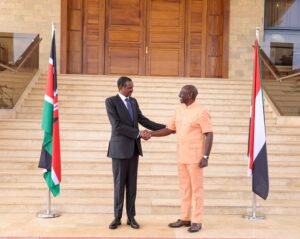
The context in which all of this unfolds is not politically neutral. President William Ruto hosted RSF commander Hemedti at State House Nairobi in 2024 — a visit that caused the government of Sudan to recall its ambassador and temporarily ban Kenyan passport holders from entering Khartoum. Ruto defended the meeting as neutral mediation under the Intergovernmental Authority on Development (IGAD) framework.
Critics, including former Chief Justice David Maraga — now a presidential contender — were not persuaded. Maraga issued a formal statement on February 26, 2026, condemning the passport issuances and warning that if they are confirmed, Kenya faces a ‘profound constitutional crisis’ with severe implications for its international standing. He called explicitly for the immediate revocation of Algoney’s Kenyan passport.
“Such actions erode trust in Kenya’s role as a regional mediator under the IGAD framework and risk tarnishing our nation’s international standing,” Maraga stated, “potentially leading to degraded passport credibility globally.”
Former Deputy President Rigathi Gachagua, himself removed from office in a parliamentary impeachment process, has claimed publicly that Algoney is not an isolated case and that additional RSF commanders may be residing in Kenya, some with Kenyan travel documents. His claims remain unverified, but they have done nothing to contain the political explosion.
The Sunday Nation reported this year, in collaboration with the Bellingcat investigative platform, that ammunition marked as belonging to Kenya’s Ministry of Defence was discovered inside RSF-controlled weapons depots on the outskirts of Khartoum. The Kenyan government has denied the allegations in categorical terms. Ruto called them ‘absolutely false.’
The convergence of a Kenyan passport in OFAC’s sanctions entry, Kenyan-marked ammunition in RSF sites, and Kenya’s deepening financial partnership with the UAE — itself the subject of persistent UN documentation as an alleged RSF weapons pipeline — has led analysts to conclude that Kenya has become, whether deliberately or through catastrophic institutional failure, a node in the RSF’s transnational logistics network.
PARLIAMENTARY FURY AND CALLS FOR BLOOD
The political response inside Kenya has been rapid and, by the standards of a political class not typically given to urgency, remarkably forceful.
Martha Karua, speaking in Nairobi over the weekend, framed the question as a simple one of accountability: “Who gave them Kenyan nationality? And these people with questionable passports are people who have taken photographs with Dr. Ruto.”
Justin Muturi, in a statement posted on social media on February 27, described the claims as “explosive” and demanded: a full public disclosure of all passports issued under the alleged arrangement; the immediate suspension and investigation of all officers involved; and a parliamentary inquiry to establish whether executive authority was abused. “Kenya must never become a laundering ground for international actors seeking legitimacy,” Muturi said.
Security analyst Dr. Luchetu Likaka did not equivocate: “Whether the passport was obtained through fraud or connections, it signals serious institutional weaknesses that must be confronted head-on.”
Analyst Chris Otieno, meanwhile, sounded the alarm on the diplomatic consequences still to come. “We are not off the hook yet with the Minnesota scandals,” he noted — a reference to the $250 million Food for Our Future fraud through which stolen American nutrition programme funds were laundered through Kenyan banks and real estate, placing Kenya under sustained US financial crimes scrutiny — “and this again emerges. We need serious diplomatic interventions to save our country from facing international sanctions.”
THE QUESTION THAT MUST BE ANSWERED
The central question in this investigation is not whether Kenyan passports ended up in the hands of RSF operatives. That is confirmed by Washington’s own records. The question — the one that determines whether this is institutional failure or institutional crime — is: who authorised it?
The ladder of accountability runs upward from the technical officers who processed the applications, through the senior officials who controlled system access, through the directorate’s leadership, and — if Boniface Mwangi’s allegation is accurate — to State House itself.
Cheluget’s position at the head of that ladder is not in question. She is the Director General. The Directorate is her responsibility. The system architecture that allegedly enabled these issuances was built during her tenure. The cartel allegations, predating the RSF revelations by months, suggest that the environment in which this happened was not anomalous but systematic.
Whether she acted on orders, acted on her own initiative, or failed to prevent others from acting — each scenario carries its own weight of institutional and potentially criminal responsibility. And in none of those scenarios does her office emerge unscathed.
What is known is this: Kenya’s maroon passport — the document that defines Kenyan identity at every border in the world — was handed to men accused of fuelling one of the century’s most brutal conflicts. The OFAC sanctions database says so. The UN says so. Washington says so.
And from Nyayo House, at the time of publication, there was only silence.