Telecommunications giant Safaricom is facing a Sh200 million compensation claim after an acquitted Moi University student accused the company of unlawfully releasing his private data to the Directorate of Criminal Investigations without a court order.
Prominent lawyer Danstan Omari on Tuesday launched a blistering attack on the telco, accusing it of disregarding constitutional safeguards and treating court pronouncements as optional.
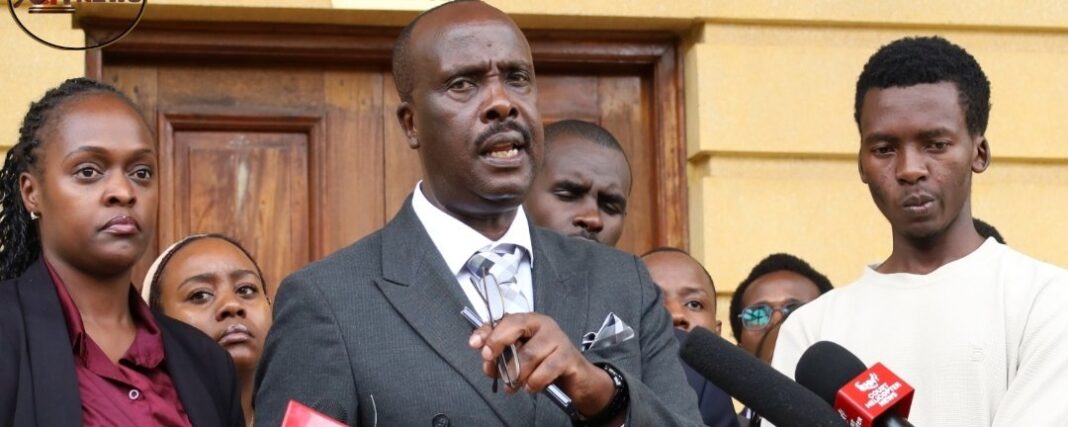
Speaking outside the Milimani Law Courts, Omari said the company had effectively admitted during criminal proceedings that it shared David Oaga Mokaya’s subscriber and location details with investigators without judicial authorisation.
“Safaricom must be held accountable. They cannot treat constitutional rights and court rulings as optional,” Omari told reporters, as he invited Kenyans who believe their data was similarly disclosed to security agencies to join what he described as a landmark privacy suit.
The claim follows Mokaya’s dramatic acquittal last week in a cybercrime case that had drawn national attention. The 24 year old finance student was charged with publishing false information over a post on X, formerly Twitter, in November 2024.
The post allegedly depicted a funeral procession with a casket draped in the Kenyan flag and referenced President William Ruto, which prosecutors argued was intended to mislead the public into believing the Head of State had died.
During the trial before Principal Magistrate Carolyne Nyaguthii Mugo at the Milimani Chief Magistrate’s Court, DCI Chief Inspector Bosco Kisau testified that investigators obtained Mokaya’s phone number and location data from Safaricom following a written request by a senior officer on November 14, 2024.
A Safaricom employee, Daniel Hamisi, confirmed under cross examination that the information was released without a court order being presented.
Mokaya was arrested the following day in Eldoret.
His Samsung phone, laptop and identification card were seized before a search warrant was obtained.
In acquitting him on February 19, 2026, the court ruled that the prosecution had failed to conclusively link him to the disputed post and found that key digital evidence had been obtained unlawfully.
Shortly after the acquittal, Mokaya’s legal team, comprising Omari, Shadrack Wambui and Martina Swiga, issued a 48 hour demand letter seeking Sh200 million for alleged violations of Article 31 on the right to privacy and Article 28 on human dignity under the Constitution, as well as breaches of the Data Protection Act, 2019.
According to court filings and Omari’s statements, Safaricom has denied liability, with its lawyers describing the allegations as false and malicious.
The company has consistently maintained that it only releases customer information when required by law or pursuant to a court order. Omari, however, insists that testimony from the firm’s own employee amounts to damning evidence of systemic non compliance.
He said a constitutional petition has been filed, or is imminent, before the High Court’s Constitutional and Human Rights Division.
He also signalled the possibility of a sweeping class action that could run into trillions of shillings if millions of affected subscribers come forward.
“This is not just about David Mokaya. It is about restoring sanity to the telecommunications sector. Every Kenyan whose privacy has been violated in this manner now has a justiciable claim,” Omari said.
The case thrusts Safaricom, Kenya’s dominant telecom operator with more than 40 million subscribers, back into the spotlight over data protection concerns.
The firm has previously faced high value data related claims, including a Sh1.432 billion suit in 2025 linked to alleged exposure of millions of customer records, alongside separate accusations of unauthorised data mining tied to betting activity.
Legal analysts note that while the Data Protection Act permits limited disclosures to law enforcement for legitimate investigations, court precedents have increasingly emphasised the need for judicial oversight, particularly where real time location data is involved.
Safaricom had not issued a fresh public statement on the Mokaya matter by Tuesday afternoon.
Its published privacy policy underscores compliance with legal requirements and international privacy management standards.
Mokaya’s lawyers are expected to seek conservatory orders to restrain any further release of subscriber data without court sanction.
The High Court’s determination could set a far reaching precedent on how telecom operators balance cooperation with security agencies against the constitutional right to privacy in Kenya’s fast evolving digital landscape.