Kenya remains committed to splitting Safaricom into three separate entities even as the government finalizes a deal that will see its stake in the telecommunications giant drop to 20 percent, Treasury Secretary John Mbadi has said.
President William Ruto’s administration wants to carve the Nairobi Securities Exchange-listed company into a mobile phone tower operator, a fintech business and a telecommunications firm, a restructuring that officials believe could exponentially increase the company’s value.
The separation plan, which has been on the government’s agenda since the 2022 campaign period, comes as Vodacom Group prepares to acquire an additional 20 percent stake in Safaricom for approximately 2.4 billion United States dollars.
The transaction will see the South African mobile operator’s shareholding increase from 35 percent to 55 percent, effectively giving it majority control of East Africa’s most valuable company.
Mr Mbadi told Bloomberg this week that the ongoing discussions about the corporate restructuring would not affect the pending transaction with Vodacom, which is awaiting regulatory approvals in Kenya, Ethiopia and South Africa.
“We feel very strongly that going forward if the three are split then obviously the value of the firm is going to increase exponentially and that is a discussion that we are still holding with Vodacom. We need to have that split if we are to maximize the value,” he said.
The proposed unbundling would see Safaricom’s telecommunications unit focus exclusively on voice and data services, the tower business manage physical network infrastructure, while M-Pesa, the company’s flagship mobile money platform, would operate as an independent financial services company under the direct supervision of the Central Bank of Kenya.
Treasury officials see the split as critical to unlocking shareholder value in a company that has become deeply woven into Kenya’s economic fabric.
The restructuring proposal gains additional weight from international bodies, with the World Bank in November urging Kenya’s communications regulator to deploy updated regulations that encourage infrastructure sharing among mobile operators.
The Washington-based lender warned in its latest report that firms with extensive coverage like Safaricom can delay, restrict or set unfavorable terms for access to network infrastructure, creating higher costs for smaller companies and potential new entrants in the telecommunications sector.
M-Pesa’s dominance in the digital payments space has long fueled calls for separation.
The platform controls more than 90 percent of mobile money transactions in Kenya and processed transactions worth approximately 36 trillion shillings in the financial year ending March 2025, according to the company’s latest results.
This represents more than half of Kenya’s gross domestic product, underlining the platform’s centrality to the country’s economy.
The push for separation has persisted through multiple parliamentary attempts over the past decade, with lawmakers arguing that Safaricom’s bundled structure creates unfair competitive advantages.
In 2021, a bill sponsored by Gem Member of Parliament Elisha Odhiambo seeking to mandate the split failed after legislators declined to debate the proposed legislation. The measure was revived in 2024 as part of the Information and Communications Amendment Bill.
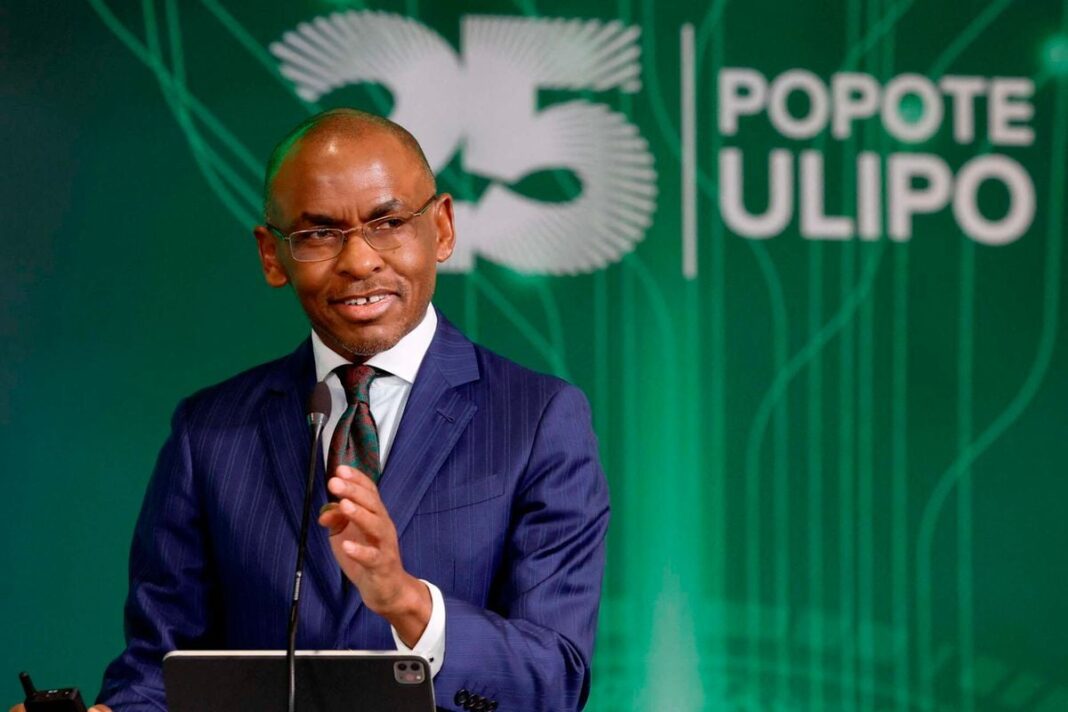
Safaricom Chief Executive Officer Peter Ndegwa has consistently resisted calls for a split, arguing that such a move would not add value for shareholders.
In May last year, Mr Ndegwa told investors the company planned to adopt a holding company structure rather than spinning off M-Pesa as a separate entity. “We do intend to go into a group structure, but we do not intend to spin off M-Pesa into a separate business. If it happens, it would be in the interest of customers or shareholders. In the absence of either, Safaricom will wait until it is required to do so,” he said at the time.
The CEO drew contrasts with regional competitors MTN and Airtel Africa, which have separated their mobile money operations, questioning whether those restructurings delivered better valuations or served pressing capital needs that Safaricom currently lacks.
The ongoing debate over separation is playing out against a backdrop of significant ownership changes at Safaricom.
Under the transaction announced last week, Vodacom is purchasing a 15 percent stake from the Kenyan government and acquiring an effective five percent stake from Vodafone International Holdings for 2.1 billion dollars.
The deal includes an additional 40.2 billion shillings advance dividend payment from Vodacom to the government, which the South African telecommunications group expects to recoup through future Safaricom dividend distributions.
Safaricom shares jumped as much as 13 percent on December 4 when the proposed deal was announced, continuing a remarkable run that has seen the stock gain approximately 65 percent this year, putting it on track for its strongest annual performance in 12 years.
The company is valued at roughly 1.2 trillion shillings on the Nairobi Securities Exchange.
Beyond the restructuring talks, Treasury officials have disclosed that Safaricom is eyeing further regional expansion, though Mr Mbadi declined to specify which markets the company plans to enter.
The telco already operates in Ethiopia, where it launched commercial services in October 2022 after paying one billion dollars for an operating license.
The Ethiopian venture has proven costly, with Safaricom Ethiopia posting losses of 21.4 billion shillings in the financial year ending March 2025, though this represents a significant improvement from the 61 billion shillings in losses recorded in the prior year.
The company has invested more than two billion dollars in Ethiopian infrastructure and had grown its customer base to 8.8 million active users by March this year.
Mr Mbadi indicated that any move into new countries would require government approval, suggesting the state intends to maintain influence over Safaricom’s strategic direction even after reducing its stake to 20 percent. “That is one of the objectives of this divestiture, that we should give space for Safaricom to do two things. They will move to fintech and the other one is to move into the region,” the Treasury Secretary said.
The government’s planned stake sale is part of a broader privatization drive aimed at raising 149 billion shillings in the 2025-26 financial year.
Kenya faces mounting fiscal pressures, with debt servicing costs consuming an increasing share of tax revenues. Between July 2023 and February 2024, the government spent 722 billion shillings on interest payments, more than half of total tax revenue during that period.
The Central Bank of Kenya has been a consistent advocate for separating M-Pesa from Safaricom’s core telecommunications business. Governor Kamau Thugge has previously noted that a tax liability of approximately 75 billion shillings has been among the factors delaying the split.
Treasury officials say they are close to resolving this tax dispute, though no final settlement has been announced.
Safaricom remains Kenya’s most profitable listed company and a significant contributor to the Exchequer.
In the last financial year, the company paid 144 billion shillings to the government, including 124.7 billion shillings in taxes and license fees and a 19.5 billion shilling dividend payout from the state’s shareholding.
For the financial year ending March 2025, Safaricom posted an 11 percent increase in net profit to 69.8 billion shillings, with service revenue rising 10 percent to 371.4 billion shillings.
The company’s customer base grew by 16 percent to 57.1 million across Kenya and Ethiopia.
M-Pesa continues to be the company’s growth engine, contributing 44.2 percent of Kenya service revenue in the last financial year, up from 42.4 percent the previous year.
The platform has 40.5 million active monthly users in Kenya and is expanding rapidly in Ethiopia, where it has attracted 2.4 million users since launching in August 2023.
The restructuring discussions come at a time when Kenya’s telecommunications sector faces growing scrutiny over competition and market dominance.
The World Bank’s recent assessment highlighted persistent gaps in infrastructure sharing rules, spectrum allocation and digital market oversight, which it said increasingly benefit large incumbents while raising costs for smaller operators and consumers.
The lender recommended that Kenya strengthen infrastructure sharing rules, implement transparent spectrum auctions, establish fairer mobile termination rates and speed up dispute resolution mechanisms to reduce costs and boost competition in the sector.
These recommendations align with the government’s stated objectives for the Safaricom restructuring, though officials have not specified a timeline for implementing the split.
Mr Mbadi’s comments suggest the government views the separation as essential regardless of ownership changes, signaling that Vodacom may need to accept the restructuring as a condition of its increased stake in the company.
The Treasury Secretary’s insistence on the split points to a determination to reshape Kenya’s most valuable company even as it cedes majority control to private investors.