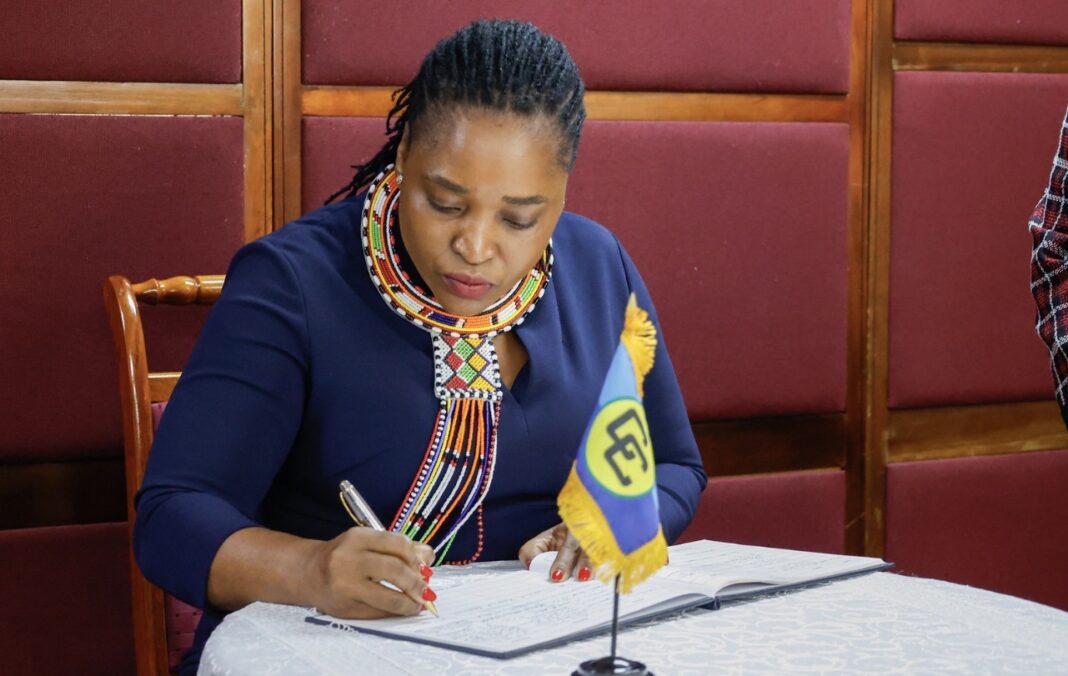
Nairobi, February 27, 2026 – Kenya’s Ambassador to Cuba, Everlyne Mwenda Karisa, is locked in a bitter court battle with Kenya Commercial Bank (KCB), accusing the lender of failing to fully account for and refund fraudulent transactions that allegedly drained funds from her linked shilling and dollar accounts while she served thousands of kilometres away in Havana.
The high-profile dispute, now before the Milimani Commercial Courts, lays bare the risks facing Kenyan account holders operating digital banking platforms from abroad.
Karisa’s legal team argues that any activity on her Kenyan mobile lines after her departure from the country should automatically have triggered red flags within the bank’s fraud detection systems.
The matter flared up this week before Senior Principal Magistrate Lucy Njora when KCB sought to have the case marked as settled.
The bank says it refunded part of the disputed funds and wrote off certain loan facilities extended during the period in question.
But her lawyer, Danstan Omari, opposed closure of the file, telling the court that no documentary evidence had been produced to demonstrate that the alleged refund of Sh779,603 was ever credited back to the ambassador’s accounts.
“The respondent has not placed before this Honourable Court any documentary proof to demonstrate that the alleged refund was made to our client’s account,” Omari submitted.
KCB maintains it credited Sh413,728.75, which it describes as the verified portion of the loss, and reversed or wrote off the impugned salary loans.
It further argues that investigations involving the Directorate of Criminal Investigations are ongoing and that the suit was filed prematurely before internal and criminal probes were concluded.
Magistrate Njora declined to terminate the proceedings at this stage. She directed both parties to file written submissions within seven days, setting March 20, 2026 as the date for a ruling on whether the matter will proceed to full hearing.
Diplomat’s nightmare from 10,000 kilometres away
Karisa, appointed ambassador in 2024 by William Ruto and stationed in Cuba since October that year, states in her affidavit that she has been accessing her KCB accounts through online banking while in Havana. Her account security, she says, relies on one-time passwords routed to her registered email address.
Her Safaricom line was last active on October 13, 2025 at Jomo Kenyatta International Airport as she travelled back to her duty station.
Yet on November 11 and 12, 2025, a series of transactions were allegedly authenticated and processed against her accounts.
Among them was a Sh150,000 mobile money transfer to her own number, funds she insists were neither received nor authorised. Seven additional transactions followed, including two KCB salary loan advances of Sh92,303 and Sh33,800.
In total, she claims Sh779,603 was siphoned off through what she terms fraudulent and irregular activity.
Crucially, her dollar account held at KCB’s Garden Plaza Branch is directly linked to her Kenya shillings account.
According to her pleadings, this structural linkage meant that once the shilling account was compromised, her foreign currency deposits were equally exposed.
“Any activity purportedly authenticated through the applicant’s Kenyan lines after 13th October 2025 is inherently suspicious and invalid,” Omari argued, questioning how transactions could be validated when the account holder was verifiably outside the jurisdiction.
Bank’s defence
In a replying affidavit sworn by branch manager Scandy Chepkurui, KCB denies negligence.
The bank contends that its internal review established the ambassador was likely out of the country at the time of the transactions and that it acted promptly to mitigate loss by crediting verified sums and freezing questionable facilities.
The lender also signals that liability cannot be conclusively determined until investigations are finalised, hinting that issues of credential compromise, third-party access or SIM-related vulnerabilities may be at play.
The case touches on a broader pattern of digital banking fraud complaints that have surfaced in Kenyan courts in recent years, particularly involving SIM swap schemes, OTP interception and unauthorised mobile loan processing.
For diplomats and Kenyans in the diaspora who rely on remote account access, the litigation raises urgent questions about risk allocation between banks and customers.
Karisa is seeking orders to suspend any further transactions on both accounts and to compel KCB to table a detailed forensic audit trail showing how the transactions were initiated, authenticated and settled within its core banking system.
As the March 20 ruling approaches, the outcome will determine whether the envoy’s claim proceeds to a substantive hearing that could require the bank to open up its internal security protocols to judicial scrutiny.
For now, the dispute stands as a rare public confrontation between a serving ambassador and one of the country’s largest financial institutions, with potentially far-reaching consequences for digital banking governance.